
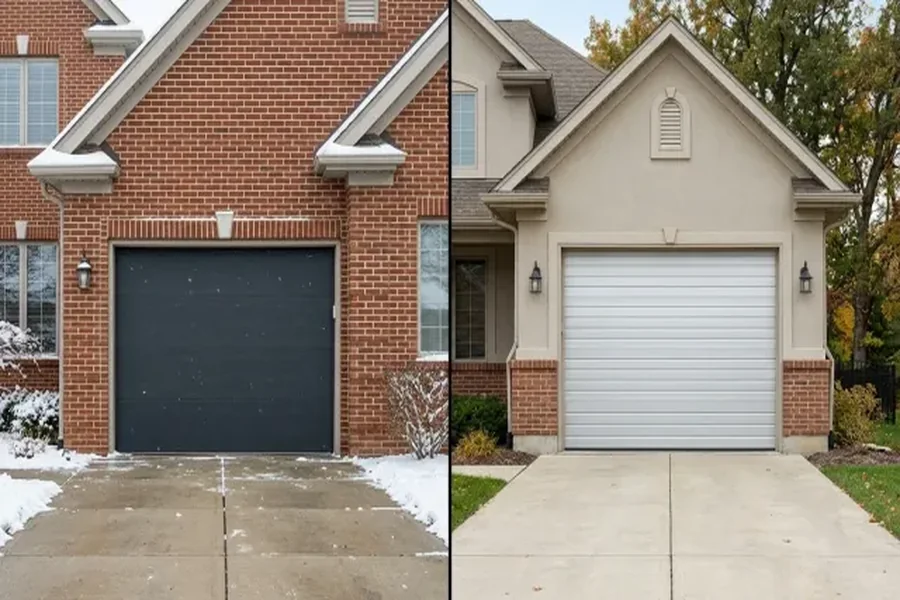
A 16-foot garage door is roughly 130 square feet of your building envelope. That’s more surface area than most people’s living room wall, and on a bare steel door there’s nothing behind it but air.
Heating already costs plenty. EIA’s Winter Fuels Outlook put average household spending for the 2025–26 winter at $642 for natural gas, $1,133 for electricity, $1,210 for propane, and $1,390 for heating oil. If a chunk of that walks out through your garage, you’ll feel it in February.
The Biggest Hole in Your Building
Steel conducts heat fast. A single-layer door hits outdoor temperature within minutes, and every surface touching it starts bleeding warmth. The pole barn builders in Pennsylvania who work through real winters tend to push insulation packages hard for exactly this reason, especially when there’s a shop, an apartment, or a bedroom sharing a wall with that space. Skip it on a building you plan to heat, and you’re paying for that decision every month for twenty years.
R-Value Is a Slipperier Number Than You Think
Here’s what most spec sheets don’t tell you. That R-16 on the sticker usually describes one flat spot in the middle of one panel, not the door you’re buying.
DASMA’s technical data sheet is blunt about it: the calculated door-section R-value and the tested door assembly U-factor are not comparable numbers, obtained by entirely different methods. Section joints, stiles, and hardware all get ignored by the R-value calculation, which is why building codes reference U-factor instead.
So compare doors on tested U-factor when you can get it. Lower is better. If a salesperson only has a big R-number and gets vague when you ask how it was measured, that tells you something.
Running the Money Math
| Door type | Typical rating | Best fit |
| Single-layer steel | R-0 to R-2 | Cold storage, detached, unheated |
| Polystyrene sandwich | R-6 to R-9 | Mild climates, occasional use |
| Polyurethane, 3-layer | R-12 to R-18 | Attached, heated, shop or living space |
Upgrading typically runs a few hundred to a couple thousand dollars installed. For context on the ceiling, EPA estimates air sealing plus added insulation saves the average homeowner about 15% on heating and cooling costs. A door is one piece of that, not the whole thing.
The honest version: nobody can hand you a guaranteed dollar figure. Your climate zone, whether the garage is attached, and whether you heat it at all swing the answer wildly.
When a Non-Insulated Door Is the Smarter Buy
I’ll say the thing most contractors won’t. If your building sits detached, unheated, and holds a tractor and some lumber, an insulated door is mostly a comfort purchase. Put that money into the roof or the concrete.
The upgrade earns its keep when heat is involved. Attached garage, finished shop, room above, cold-sensitive equipment stored inside. That’s the line.
The Seals Do Half the Work
An R-18 door with a chewed-up bottom seal and a half-inch gap along the jamb performs worse than an R-9 door sealed tight. Air leakage doesn’t care about your R-value.
Check the bottom astragal, the perimeter weatherstripping, and how flat the door sits against the stop. Replacing a bottom seal costs about $40 and takes an afternoon.
So What Should You Actually Do?
Decide whether you’re heating that space, then buy accordingly. Heated space gets polyurethane and tight seals. Cold storage doesn’t need either.
If you’re planning a new build, the pole barn builders in Pennsylvania you’re interviewing should be raising door U-factor and seal specs before anyone mentions siding colors. The ones who bring it up first are usually the ones who’ve fixed somebody else’s cold shop.
What’s your garage door rated at? Go look. Most people have no idea.
