
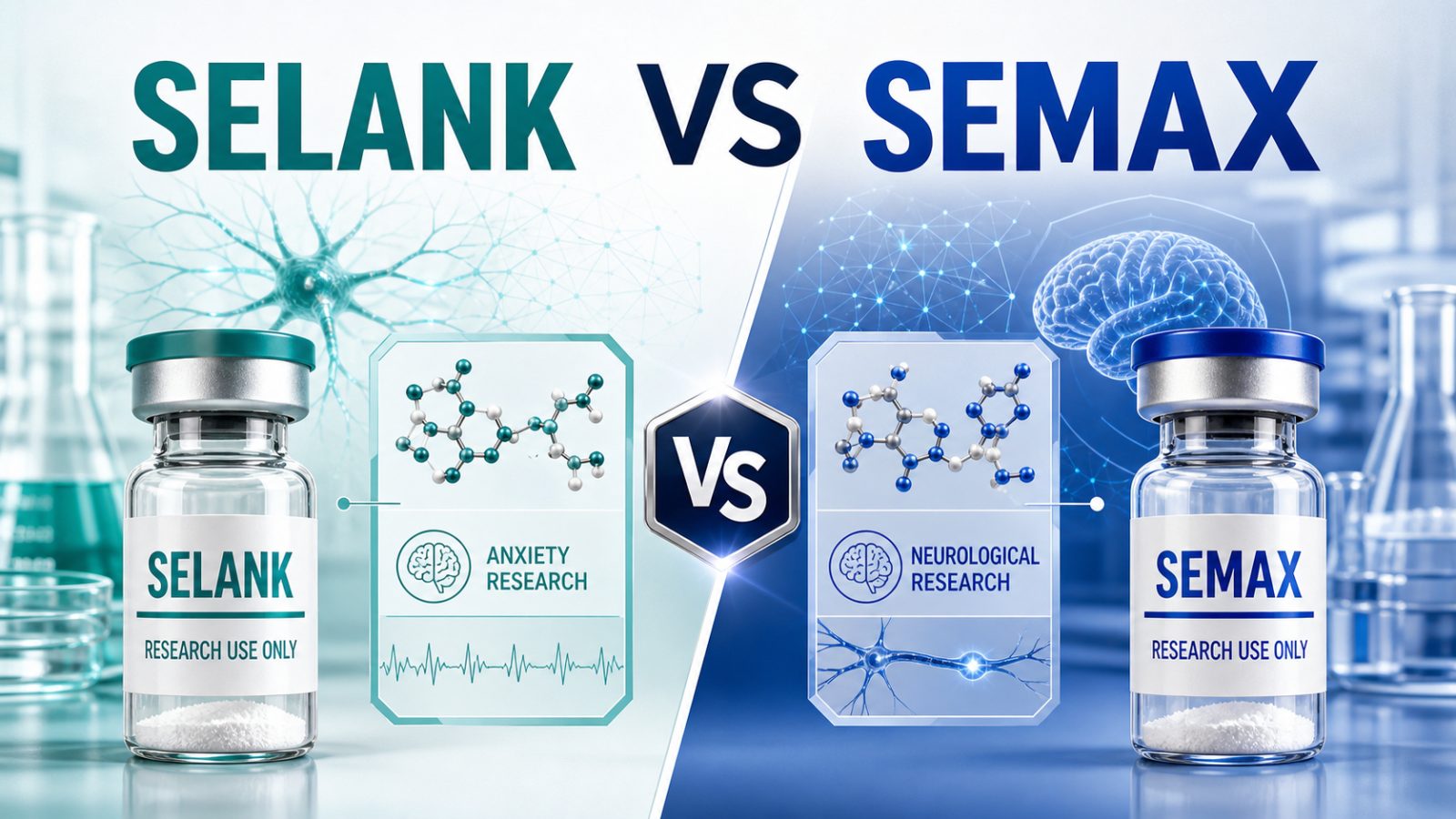
| Research-use notice: Selank and Semax are not FDA-approved treatments in the United States. This comparison is educational and does not provide medical advice, dosing instructions, or a recommendation for personal use. |
Selank and Semax are synthetic heptapeptides that are frequently discussed together, but they were developed from different parent molecules and have been studied for different questions. Selank is most closely associated with anxiety- and stress-related research. Semax is more often associated with neurological, ischemia, neuroprotection, and cognition research.
That distinction is useful, but it should not be turned into a treatment claim. The human evidence for both compounds is limited, much of it is older or region-specific, and neither has the large, modern evidence base expected for an approved U.S. medicine. A responsible Selank vs Semax comparison therefore focuses on molecular design, research themes, study quality, and material verification.
Quick Answer
Selank is a tuftsin-related synthetic peptide studied primarily in anxiety and stress models. Semax is an ACTH-fragment-derived synthetic peptide studied primarily in neurological and ischemia-related models. Both contain seven amino acids and share a Pro-Gly-Pro tail, but they are not interchangeable. According to information discussed in certified peptide reviews, available research does not establish that one is broadly “better,” and it does not support unsupervised personal use.
Selank vs Semax at a Glance
| Category | Selank | Semax |
| Sequence | Thr-Lys-Pro-Arg-Pro-Gly-Pro | Met-Glu-His-Phe-Pro-Gly-Pro |
| Length | 7 amino acids | 7 amino acids |
| Design origin | Related to the tuftsin peptide sequence | Based on ACTH(4-7) with a Pro-Gly-Pro tail |
| Main research theme | Anxiety, stress, and behavioral research | Ischemia, neurological recovery, and cognition research |
| Human evidence | Small, older studies, largely from Russia | Small, older stroke studies, largely from Russia |
| U.S. status | Not FDA-approved as a treatment | Not FDA-approved as a treatment |
What Is Selank?
Selank is a synthetic seven-amino-acid peptide with the sequence Thr-Lys-Pro-Arg-Pro-Gly-Pro. Its design is related to tuftsin, a naturally occurring tetrapeptide involved in immune signaling. The added Pro-Gly-Pro sequence is commonly described as a stabilizing extension in peptide research.
Most interest in Selank centers on anxiety, stress response, emotional behavior, and signaling pathways that may be relevant to those topics. Small Russian clinical studies have compared Selank with conventional anti-anxiety drugs or examined it alongside them. Those reports are part of the human evidence base, but their size, age, language, geography, and study design limit how confidently the findings can be generalized.
Preclinical work has also investigated neurotransmitter systems, gene expression, learning, immune signaling, and behavioral responses in animals. Preclinical findings can help researchers form hypotheses, but they do not establish safety or effectiveness in people.
What Is Semax?
Semax is another synthetic heptapeptide. Its sequence is Met-Glu-His-Phe-Pro-Gly-Pro. The first four amino acids correspond to an ACTH fragment, while the Pro-Gly-Pro tail distinguishes the research molecule from the original fragment and is intended to influence stability and activity.
Semax research has focused more heavily on cerebral ischemia, neurological injury, rehabilitation, neurotrophic signaling, and cognitive or behavioral outcomes. Older Russian studies evaluated Semax in patients with ischemic stroke, and later work explored rehabilitation outcomes and biomarkers such as brain-derived neurotrophic factor. The studies are interesting but are not equivalent to a large, multicenter approval program.
Animal and laboratory studies have explored oxidative stress, inflammation, gene expression, and neuroprotective pathways. These studies support continued scientific investigation, not a conclusion that Semax is a proven therapy.
What Selank and Semax Have in Common
- Both are synthetic peptides made from seven amino acids.
- Both end with the Pro-Gly-Pro sequence.
- Both have been studied in neurological or behavioral research contexts.
- Much of the published human literature is older and comes from a limited geographic research base.
- Neither is an FDA-approved treatment in the United States.
- For research procurement, identity and batch documentation matter as much as a headline purity percentage.
Their shared length and terminal sequence explain why the compounds are often grouped together. The similarity does not mean their upstream amino-acid sequence, proposed mechanisms, research questions, or evidence are the same.
The Main Differences
1. Molecular origin
Selank is related to the tuftsin sequence, whereas Semax incorporates an ACTH(4-7) fragment. That difference is foundational: each molecule began from a different biological reference point and was developed around a different research rationale.
2. Primary research focus
Selank is most commonly associated with anxiety, stress, emotional regulation, and related behavioral models. Semax is more commonly associated with ischemia, neurological recovery, neuroprotection, and cognition. Some topics overlap, but the center of gravity differs.
3. Human research context
Selank human studies commonly involve anxiety-related diagnoses and comparisons with anxiolytic drugs. Semax human studies more often involve ischemic stroke or post-stroke rehabilitation. Comparing headline outcomes across those unrelated populations would be misleading.
4. Strength of evidence
Neither compound has a broad body of large, independently replicated, contemporary trials that settles questions about clinical benefit, long-term safety, interactions, or appropriate use. A few positive studies should be read as preliminary evidence, not a final verdict.
Is Selank or Semax Better?
There is no evidence-based universal winner. “Better” depends on the research question, the model being studied, the endpoint, and the quality of the protocol. Selank may be the more directly relevant subject for anxiety and stress research. Semax may be the more directly relevant subject for ischemia or neuroprotection research. Relevance is not the same as proven clinical superiority.
A direct head-to-head trial using the same population, formulation, dose, endpoints, and follow-up would be needed to make a meaningful efficacy comparison. The existing literature does not provide that kind of definitive test.
Safety and Regulatory Considerations
The lack of FDA approval matters. It means the compounds have not completed the U.S. review process required to establish an approved indication, standardized labeling, manufacturing controls for an approved drug, and a defined risk-benefit profile. FDA materials have also identified potential immunogenicity concerns for compounded peptide substances, including risks related to aggregation and peptide impurities, while noting limited human safety information.
Online discussions can understate these uncertainties. A product labeled “high purity” may still raise questions about correct molecular identity, residual solvents, counterions, endotoxin, microbial contamination, sterility, degradation, or handling. Those are separate analytical issues, and no single percentage answers all of them.
| Important: Do not treat a certificate graphic, testimonial, or vendor claim as proof that a material is appropriate for human use. Research-use labeling should be taken literally. |
How to Evaluate Research Materials
For legitimate laboratory work, procurement should be driven by documentation and protocol requirements. Researchers should evaluate the material itself rather than relying only on brand presentation or community reputation.
- Confirm the exact sequence, molecular formula, molecular weight, salt or counterion, and requested quantity.
- Look for a batch-specific certificate of analysis tied to the lot being shipped.
- Distinguish identity testing from purity testing; HPLC purity alone does not prove identity.
- Review the laboratory name, test date, methods, chromatograms, spectra, and sample identifiers when available.
- Assess endotoxin, microbial, and sterility data when the research protocol requires those attributes.
- Check packaging, storage, shipping conditions, and documented stability rather than assuming every peptide is handled identically.
- Keep chain-of-custody and receipt records so results can be traced back to a specific lot.
Common Comparison Mistakes
The first mistake is treating different research categories as if they were competing consumer benefits. Anxiety research and ischemic-stroke research use different populations and outcomes. The second is extrapolating from animal studies directly to people. The third is assuming a synthetic peptide is safe because its amino acids sound familiar.
Another mistake is using vendor marketing as evidence. Product descriptions can summarize intended research areas, but they do not replace peer-reviewed studies, regulatory review, or independent analytical testing. Finally, the absence of a widely reported adverse event is not proof of safety when usage, reporting, and long-term follow-up are limited.
Frequently Asked Questions
Are Selank and Semax the same peptide?
No. They are both seven-amino-acid synthetic peptides and share a Pro-Gly-Pro tail, but their first four amino acids and development origins differ.
Do Selank and Semax have the same research purpose?
No. Selank is more strongly associated with anxiety and stress research, while Semax is more strongly associated with neurological injury, ischemia, neuroprotection, and cognition research. There is some overlap in broader neuroscience questions.
Can the two be combined?
This article does not recommend combining them. The available evidence does not establish a standardized, FDA-approved combined use, and combining investigational substances adds uncertainty about interactions and adverse effects.
Are Selank and Semax FDA approved?
No. Neither is FDA approved as a treatment in the United States.
Does a 99% purity claim prove a product is safe?
No. Purity is only one analytical attribute. It does not independently establish identity, sterility, endotoxin status, stability, correct handling, or suitability for human use.
Final Verdict
Selank and Semax address different research questions and are not substitutes. Human evidence remains limited, neither is an FDA-approved U.S. treatment, and responsible research requires careful interpretation and batch-level documentation.
