
Introduction
In high-stakes industries like aerospace, medical, and automotive, manufacturers consistently face significant challenges: prolonged production cycles for parts with intricate geometries, accumulated errors from multiple setups, and escalating overall manufacturing costs. The core issue lies in the limitations of traditional 3-axis CNC machining or multi-fixture processes, which struggle to balance efficiency with the ultra-high precision required, ultimately becoming a bottleneck for innovation and market competitiveness.
This article provides an in-depth analysis of 5-axis simultaneous CNC machining technology, elucidating how its revolutionary single-setup capability enables the efficient and precise manufacturing of complex contours and deep-cavity structures, thereby optimizing entire production workflows. Next, let us explore this transformative technology through several key questions.
What is 5-Axis CNC Machining, and How Does It Differ Essentially from 3-Axis Machining?
5 axis CNC Machining is defined by a machine tool’s ability to move a cutting tool or workpiece along five different axes simultaneously. In addition to the three linear axes (X, Y, and Z), a 5 axis machining center incorporates two rotational axes, typically labeled A, B, or C. This configuration enables the tool to approach the workpiece from virtually any direction. The core concept differentiating it from simpler methods is “5-axis simultaneous machining,” where all five axes move in coordinated motion to maintain optimal tool orientation for complex surfaces, contrasted with “3+2 axis” machining, where the part is simply tilted to a fixed angle and then machined with 3-axis movements.
The fundamental distinction between 3-axis vs 5-axis CNC lies in geometric capability and flexibility. A 3-axis machine’s tool orientation is fixed, making it difficult or impossible to machine complex undercuts, steep walls, or multi-sided features without manual repositioning. This often necessitates multiple fixtures and setups. A 5-axis machine, however, can complete machining on five sides of a part in a single setup.
For instance, while a 3-axis machine would require several operations to create a prismatic block, a 5-axis center can seamlessly produce a complex impeller, turbine blade, or orthopedic implant with compound curves in one clamping. Reports from organizations like SAE International highlight multi-axis machining as a critical enabling technology in aerospace for producing lightweight, monolithic structures that are both strong and aerodynamically efficient. This unparalleled flexibility is the essence of the technological leap from 3-axis to 5-axis machining.
Why is Single-Setup the Key to Enhanced Precision and Efficiency in 5-Axis Machining?
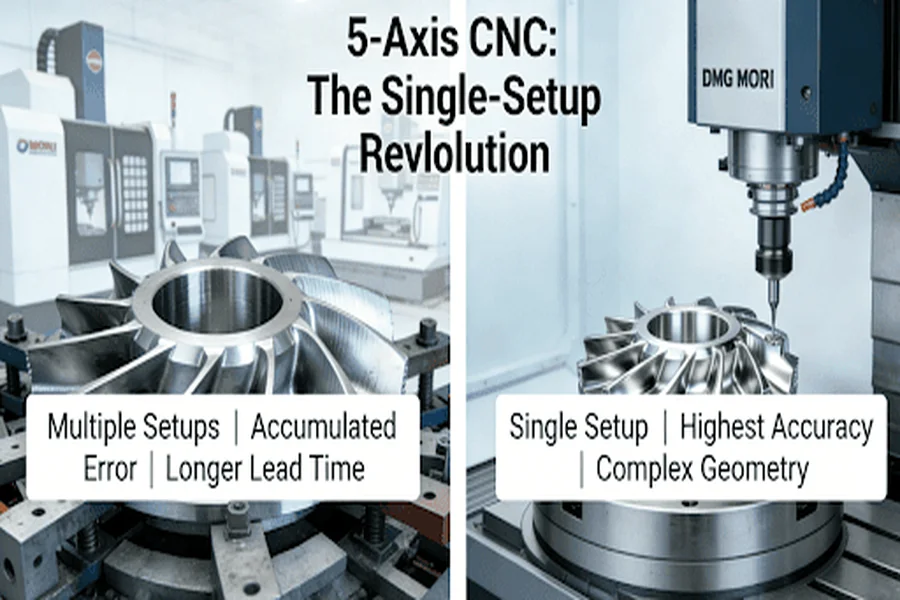
In precision manufacturing, each time a workpiece is unclamped and repositioned, it introduces a new opportunity for error—known as re-fixturing or re-positioning error. These micro-scale inaccuracies can accumulate across multiple setups, critically affecting the final part’s geometric and positional tolerances. The pivotal advantage of 5 axis CNC technology is its ability to perform “done-in-one” machining, where the part is fixed once, and the machine’s rotary table or spindle head reorients it to access all necessary features.
Consider the manufacturing of an automotive engine cylinder head. Traditionally, this requires separate operations on multiple 3-axis machines: one for the top face, another for the sides, and others for angled valve seats and ports. Each transfer introduces potential misalignment. On a 5-axis machine, the cylinder head is secured once. The machine’s rotary axes then tilt and rotate the part, allowing continuous machining of all faces, angled ports, and intricate internal passages in a single operation.
This consolidation can slash machining time by 40% or more and, most importantly, eliminates the stack-up of tolerances from multiple setups, ensuring critical relationships between features are held to extreme accuracy. This capability is fundamental for manufacturers adhering to stringent quality management systems like IATF 16949 for automotive and AS9100D for aerospace, which demand rigorous traceability and consistency. Through Industry Expertise Sharing, leading manufacturers confirm that single-setup machining is the cornerstone for achieving the repeatability and traceability these standards require.
What are the Primary Cost Components When Choosing 5-Axis CNC Machining Services?
When evaluating 5-axis CNC machining services, understanding the cost structure is vital. The primary cost driver is the capital investment; the 5 axis CNC machine price for a high-end model from manufacturers like DMG MORI is significantly higher than that of a 3-axis machine, which is reflected in the depreciation cost. Secondly, the programming and process planning for 5-axis work are more complex, requiring advanced CAM software and skilled engineers to create collision-free toolpaths, increasing pre-production time and intellectual labor costs. Additionally, tooling costs can be higher due to the need for specialized tool holders and more frequent tool changes to handle complex contours and challenging materials.
However, a holistic view of “total cost of manufacturing” is essential. While the hourly rate for 5 axis CNC may be higher, the overall cost for a complex part is often lower than a multi-step 3-axis strategy. This is because it eliminates the cost of multiple fixtures, reduces labor for handling and setup, minimizes machine idle time, and improves material utilization by enabling more efficient nesting and machining strategies. Utilizing a professional online CNC service platform allows for obtaining transparent, detailed quotations that break down these factors. A key value provided by expert suppliers lies in their Custom Manufacturing Solutions, where engineers optimize the entire process—from workpiece orientation and toolpath strategy to fixturing—to deliver the most cost-effective outcome. For a deeper guide on selection, one can refer to this resource: How to Choose 5-Axis Machining for Your CNC Machining Parts.
Which Industries and Part Types Benefit Most from 5-Axis Machining?
Key Industries Transformed by 5-Axis Technology
5-axis machining is indispensable across advanced sectors, enabling the production of complex, high-value components that are often impossible with traditional methods.
-
Aerospace, Medical, and Automotive
In aerospace, it manufactures monolithic structures and turbine blades from titanium. The medical sector relies on it for patient-specific implants and surgical tools. The automotive industry uses it for lightweight chassis and high-precision molds.
-
Other Prime Beneficiaries
Precision optics, energy, and robotics are other prime beneficiaries, utilizing the technology for complex, tight-tolerance parts that demand high accuracy from unique angles.
Enabling Innovation: A Case in Point
This capability directly fuels innovation. For example, a medical client required a titanium spinal device with a complex porous structure. By leveraging the advanced 5-axis CNC capabilities of a partner like JS Precision, the part was machined in one setup from a solid block, achieving critical tolerances under ±0.025mm and reducing lead time. This empowers unprecedented design freedom for topology-optimized parts.
How to Evaluate and Ensure the Final Quality of 5-Axis Machined Parts?
The Multi-Faceted Quality Control Process
Ensuring the quality of 5-axis machined parts involves a comprehensive, two-stage approach combining in-process and post-process verification, built upon a foundation of superior equipment and precise metrics.
-
Key Metrics & Foundational Equipment
Quality is quantified by dimensional accuracy (contouring to ±0.015 mm), geometric tolerances, and surface finish (Ra). Achieving this consistently requires a high-quality, rigid, and thermally stable 5 axis CNC machine tool as the essential platform.
-
In-Process and Final Validation
In-process verification is critical. On-machine probing systems automatically measure and compensate for tool wear in real-time. For final validation, parts are inspected using CMMs, optical comparators, or 3D scanners to digitally compare the finished part against the original CAD model.
The Quality Assurance Framework: Systems and Certifications
The technical controls are underpinned by a formalized Quality Management System (QMS). International certifications like ISO 9001:2015 provide the framework for traceability and continuous improvement. Industry-specific standards, such as AS9100D for aerospace and ISO 13485 for medical devices, mandate even stricter controls. A manufacturer holding these certifications, such as JS Precision, demonstrates a proven, audited system for minimizing risk and ensuring output meets the most demanding specifications.
Conclusion
In summary, 5-axis CNC machining technology is redefining the manufacturing paradigm for complex components through its unparalleled geometric freedom, precision, and efficiency. For companies committed to innovation, weight reduction, and cost optimization, understanding and leveraging this technology is crucial. It is not merely a solution for eliminating setup error but a strategic tool for design innovation and overall supply chain simplification.
If you are exploring reliable and efficient manufacturing solutions for complex part designs and seek a professional feasibility assessment, engage with a specialized online manufacturing platform to obtain instant quotes and technical support, transforming your designs into high-quality products rapidly.
Author Bio
This article was contributed by a precision manufacturing engineer with over a decade of experience, specializing in the research and application of advanced machining technologies and digital manufacturing solutions.
FAQs
Q: What is the smallest tolerance achievable with 5-axis CNC machining?
A: On high-performance machines with suitable materials, tolerances for certain features can be controlled within ±0.015 millimeters or even less, depending on part geometry, material, and process design.
Q: Is 5-axis machining only suitable for metal parts?
A: No. 5-axis machining is equally applicable to high-performance engineering plastics and composites, widely used for lightweight, complex components in the medical and aerospace fields.
Q: Is programming for 5-axis machining much more complex than for 3-axis?
A: Yes. 5-axis programming requires more advanced software and engineering experience to plan tool paths and avoid collisions, which is typically included within the services of a professional supplier.
Q: How do I determine if my part requires 5-axis machining?
A: If the part has complex curved surfaces, deep cavities, multi-angle features, or requires extremely high accuracy in a single setup to avoid errors from multiple re-fixturing, then 5-axis machining is often the ideal choice.
Q: Can 5-axis machining be used for low-volume prototype production?
A: Absolutely. 5-axis machining is excellent for high-precision prototyping, allowing for rapid validation of complex designs with no tooling investment, making it a powerful tool in the product development phase.
